The Competition Is Not the Problem
Every time I think about building something new, I can find a reason not to do it.
Usually the easiest reason is competition.
There are already hundreds of weather apps. There are plenty of URL shorteners. The App Store does not need another QR code scanner. Someone has already built a golf swing camera.
All of that is true.
It is also not a good reason to stop.
Some of my most successful projects were built in crowded markets. I did not invent weather forecasts, short links, QR codes, or browser extensions. I found a small part of the experience that bothered me and made it better.
That has turned out to matter more than having a completely original idea.
Crowded Does Not Mean Solved
I built Weather Extension because checking the weather on my computer was more work than it should have been.
Weather websites already existed. So did weather apps and other extensions. But I wanted the current temperature in the browser toolbar and a quick forecast without opening a heavy site full of ads.
That was the whole idea.
It was not a new market. It was a narrower solution to a common problem. Lifehacker eventually shared it, hundreds of thousands of people started using it, and millions of people have installed it over the years.
I did not have to beat every weather product. I had to make one workflow faster.
That is an important difference.
T.LY Entered An Even More Crowded Market
Starting a URL shortener might look like an even worse idea.
Bitly and TinyURL had been around for years. Google had its own shortener. There were already plenty of smaller services too.
I started with a Link Shortener browser extension that made creating a short link a one-click job. When Google shut down its shortener, people went looking for an alternative and the extension was already there.
The extension eventually led me to build T.LY as the service behind it. The position was simple: make short links easy to create, keep the product affordable, and give people the useful parts of link management without forcing them through an enterprise sales process.
The bigger products had more people, more money, and more brand recognition. They also had pricing changes, extra steps, and workflows that were not built for everyone. That left room for a simpler option.
A mature market can still have frustrated customers. In fact, it usually does.
Most Competitors Are Not Competing With You
Search for almost any software idea and the results look intimidating.
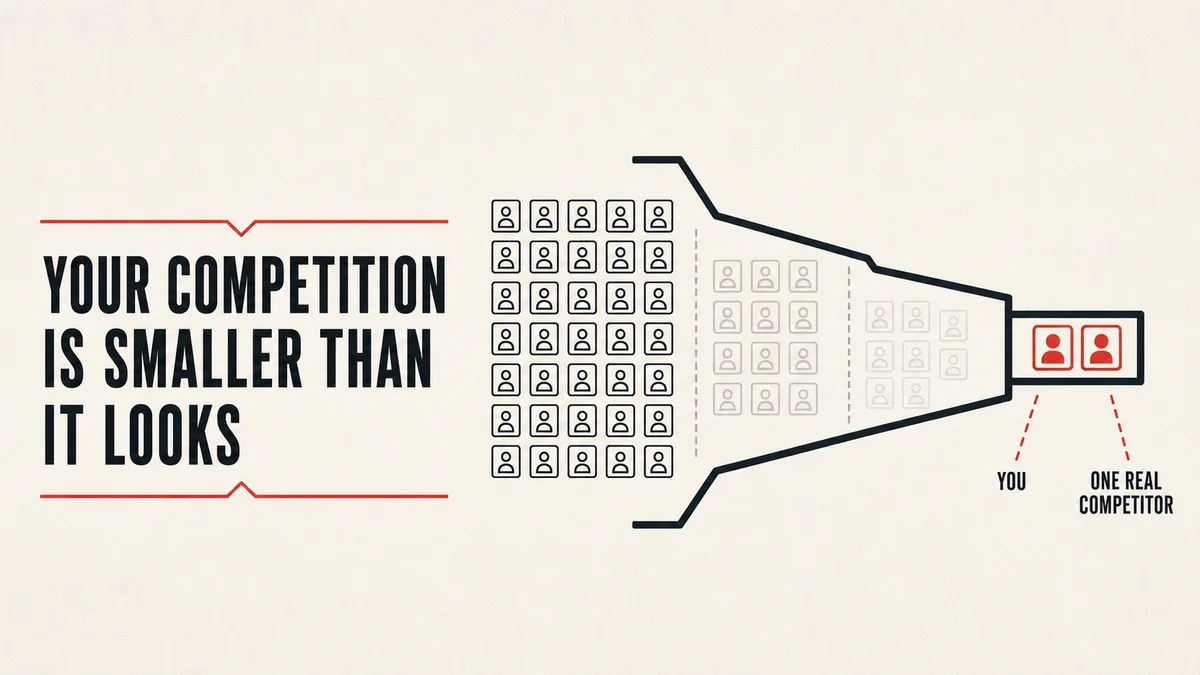
You will find dozens of products. But a product listing is not the same thing as an active competitor.
Some have not been updated in years. Some are side projects the creator stopped supporting. Some are aimed at enterprise customers when you want to serve individuals. Some are packed with features but make the basic job harder. Some are good products with slow support. Others will disappear six months after launch.
The real list gets smaller once you ask who is still improving the product, answering customers, fixing bugs, writing about the problem, and showing up a few years later.
That does not mean competition is fake. If you copy an existing product, add nothing useful, and expect people to find it on their own, the market will probably ignore you.
Shipping is only the start. I have written before that marketing is the hard part. You still need a clear reason for someone to choose your product and a way for those people to discover it.
But the number of search results is not the number of serious competitors.
AI Will Create More Apps
AI is going to increase the competition. It already has.
Someone can describe an idea, generate a working prototype, and put up a landing page in a weekend. App stores and search results will get noisier. We will see more clones, more thin AI wrappers, and more products that look finished in a screenshot.
But ask your ten closest friends who do not work in tech what they are building right now.
How many are working on an app? How many launched a product this year? How many want to spend their nights answering support emails, fixing edge cases, writing documentation, and figuring out how to get customers?
I would bet the answer is close to zero.
AI makes it easier for someone to try building. It does not make everyone want to become a product builder. Even among the people who start, a much smaller group will keep working after the fun prototype is done.
That is where the real work starts.
A demo is not a business. A generated app is not automatically a useful product. Someone still has to understand the customer, make good product decisions, earn trust, handle support, improve the rough parts, and find distribution.
AI makes serious builders faster. It also helps unserious builders create demos faster. Both things can be true.
The bar will move. Simply having a working app will be less impressive than it used to be. But a focused product that solves a real problem and keeps getting better will still be rare.
Persistence Compounds
My projects make more sense as a chain than as a collection of separate ideas.
Read Later taught me how to build browser extensions. That experience helped me build Weather Extension. Weather Extension taught me how to support a large user base and how useful the browser extension ecosystem could be for distribution.
Later, I built a tool to study the Chrome Web Store and find neglected extension categories. That led to the URL Shortener extension. The extension created demand for a reliable service behind it, which became T.LY.
None of those steps guaranteed the next one would work. But each project made me a little faster and gave me a better idea of what to look for.
This is the part people miss when they compare their first launch to someone else’s successful product. The product may be new. The experience behind it is not.
Quitting Can Be The Right Move
Persistence does not mean keeping every idea alive forever.
I have shut down a lot more projects than I currently run. Adivize had a working digital signage pilot, but the sales model had a chicken-and-egg problem. Social Traders got real usage, then Facebook launched Marketplace. GrubPress worked, but restaurant owners were not looking for it.
Keeping those products alive would not have proved anything. It would have taken time away from better opportunities.
The goal is not to be stubborn about one product. The goal is to stay in the game long enough to get better at choosing and building products.
Do not confuse giving up on one idea with giving up on building.
Those are very different decisions.
I Still Build In Crowded Categories
My recent projects follow the same pattern.
There are many golf apps, but I built Golf Swing Camera because I was tired of recording long slow-motion videos, trimming every clip, and filling up my camera roll. Then I built a free Golf Swing Analyzer because reviewing and marking up a swing on a bigger screen was still more complicated than it needed to be.
There are countless QR scanner apps too. I still built QR Code Scanner & Creator because too many of them turn a basic utility into an ad-filled subscription. I wanted a free app with local history, no account, and no weird scan limit.
I did not discover new categories. I noticed specific annoyances inside old ones.
That is usually enough to start.
What Matters More Than The Competitor Count
Before building, I would rather answer these questions:
- Is this a real problem I understand?
- Can I explain why my version should exist?
- Is there a smaller workflow I can make much better?
- Do I know how the first users might find it?
- Am I willing to keep improving it after the launch is no longer exciting?
- Will I move on if the evidence says the idea is not working?
Those questions are harder than counting competitors. They are also more useful.
Competition can be a good sign. It proves people care about the problem and may already pay to solve it. A market with no competition might be wide open. It might also mean nobody wants the product.
You do not need an empty market. You need a useful angle, a way to reach people, and enough patience to keep going after the first version.
There will always be someone else building something similar.
Start anyway.
September 2026 update: Weather Extension now has an iOS app. WeatherExt for iPhone, iPad, and Apple Watch includes hourly forecasts, radar, animated skies, and widgets. Download on the App Store.